One of the things that ican be both exhilirating and deeply frustrating for a professional astronomer is the amount of switching that happens. One hour teach, then respond to email, write proposal, respond to more email, talk to student, what was I doing again?
It gets worse when on top of that I get tired and the first thing to go is the part of the brain that handles priorities. Suddenly spending time on a low priority is fine only to realize that I should have been working on this lecture/proposal/urgent thing.
So focus...or blog...suggestions for improvements are welcomed...
Tuesday, May 16, 2017

Tuesday, May 9, 2017
Time (well) spent
So for this past semester I've been diligently toggling my time. This is in part thanks to Matt Kenworthy, in part a desire to track what I've done so I can show it and part a way to just focus on a single thing.
I did not work at 100% efficiency at all times. Obviously. Sometimes these are hours where the tv was on and I was picking at a laptop working on a proposal or something. Honestly I am trying to get rid of "work" times like that. Either veg or not.
That being said. I was a hectic first semester with much last minute improvisation (not my favorite) and making up for earlier mistakes (even less my favorite). Yet is broke down like this:

Which is I have to say... not too bad. But keep in mind that it was ~60 hr a week. And it wasn't like I left toggl running and then just "kept idle time". That is a lot of hours worked. And a lot on other/admin. But note the 25% on grant/telescope proposal writing.
Yeah that eats up a lot of my time already. To be more efficient, I strongly suggest brain dumping the idea as soon as the call comes out and refine only in the week leading up. This is probably a bit skewed since all the major deadlines were in this semester (think HUBBLE!) and the HST cycle was 1.5 years so I threw everything I had at it. Still. A lot of time...

This gives a good idea for the time individual projects took. Note HST clocking in at 136 hours... but given I put in 8...that is 17 hours per proposal. Most of them re-writes/polishes but it gives a good idea how much time it takes. Really a week for one. At least...
That 76 hour Keynote? A public talk I gave. The email is a low estimate since I count that as a "everything" entry but I do lots of reply/triage on the bus while not toggling that.
All in all ok but must have a critical look as to improve efficiency or just not do stuff since 60hr/week is too much. And inherently inefficient.
I did not work at 100% efficiency at all times. Obviously. Sometimes these are hours where the tv was on and I was picking at a laptop working on a proposal or something. Honestly I am trying to get rid of "work" times like that. Either veg or not.
That being said. I was a hectic first semester with much last minute improvisation (not my favorite) and making up for earlier mistakes (even less my favorite). Yet is broke down like this:

Which is I have to say... not too bad. But keep in mind that it was ~60 hr a week. And it wasn't like I left toggl running and then just "kept idle time". That is a lot of hours worked. And a lot on other/admin. But note the 25% on grant/telescope proposal writing.
Yeah that eats up a lot of my time already. To be more efficient, I strongly suggest brain dumping the idea as soon as the call comes out and refine only in the week leading up. This is probably a bit skewed since all the major deadlines were in this semester (think HUBBLE!) and the HST cycle was 1.5 years so I threw everything I had at it. Still. A lot of time...

This gives a good idea for the time individual projects took. Note HST clocking in at 136 hours... but given I put in 8...that is 17 hours per proposal. Most of them re-writes/polishes but it gives a good idea how much time it takes. Really a week for one. At least...
That 76 hour Keynote? A public talk I gave. The email is a low estimate since I count that as a "everything" entry but I do lots of reply/triage on the bus while not toggling that.
All in all ok but must have a critical look as to improve efficiency or just not do stuff since 60hr/week is too much. And inherently inefficient.
Monday, May 8, 2017
Monographs
I attended a workshop for young faculty (I'm young!...well for faculty...). It was about writing, something I feel I struggle with a lot. I do alright (pretty high output) but I then read something that JD Dalcanton or her many students has written and have to just admire the writing.
Much of writing is the editing of course. I am re-learning that as I am now editing down a MsC report into an A&A paper. It's tough and requires focus. Focus is where is all lies really. The ability to do deep work. And distractions aren't just the UPS flights that land practically on my head here. It's twitter, facebook, politics global and local etc. It all...distracts...
So I read the book by Scalzi on writing ("Your hate mail will be graded" etc) and I try this blog. Quick writing exercises.
Back to the workshop. These are very considerate in that these are organized. How do I write? Put all my effort in grant writing? Papers? And the question came up on the writing of a book (monograph) which is essentially a requirement for tenure in certain fields (not astronomy thankfully) and the advice was to get up at the crack of dawn (middle of the night really) and write 1-2 hours with a word count target. Edit later but hammer out that word count. Unfortunately the advice on prioritizing is...harder for a panel to give and thus we end up with Do All The Things once more...
It struck me also how it strange it is that a University requires such a Deep Work effort all the while not really providing the environment to hammer it out. Now I strongly suspect nothing but gibberish would appear if I start writing at 5am but I agreed with the carve-out-time-interval and dedicate it to writing and also that it should be every workday. And mornings should hopefully work best. But 5am? Really?
So here goes...blog/articles/grant prop...
PS: I am glad there is no need for another astronomy book. I would have serious issues getting up so early and write one...
Much of writing is the editing of course. I am re-learning that as I am now editing down a MsC report into an A&A paper. It's tough and requires focus. Focus is where is all lies really. The ability to do deep work. And distractions aren't just the UPS flights that land practically on my head here. It's twitter, facebook, politics global and local etc. It all...distracts...
So I read the book by Scalzi on writing ("Your hate mail will be graded" etc) and I try this blog. Quick writing exercises.
Back to the workshop. These are very considerate in that these are organized. How do I write? Put all my effort in grant writing? Papers? And the question came up on the writing of a book (monograph) which is essentially a requirement for tenure in certain fields (not astronomy thankfully) and the advice was to get up at the crack of dawn (middle of the night really) and write 1-2 hours with a word count target. Edit later but hammer out that word count. Unfortunately the advice on prioritizing is...harder for a panel to give and thus we end up with Do All The Things once more...
It struck me also how it strange it is that a University requires such a Deep Work effort all the while not really providing the environment to hammer it out. Now I strongly suspect nothing but gibberish would appear if I start writing at 5am but I agreed with the carve-out-time-interval and dedicate it to writing and also that it should be every workday. And mornings should hopefully work best. But 5am? Really?
So here goes...blog/articles/grant prop...
PS: I am glad there is no need for another astronomy book. I would have serious issues getting up so early and write one...
Tuesday, April 18, 2017
First post as an Associate Professor
The blog has been quiet for a while. Why was that?...oh right. International move with kids, cold start to a 100-student physics class, the sudden urgent need to get grants, a parade of proposal deadlines...did I mention teaching and the move?
Well the move is done. We are indeed here. Here being Louisville, Kentucky. It took a lot more work and lots of shenanigans before we actually in a house of sorts, going to work and school etc. Much has been done by Robin, especially on the school stuff. C is going through the hoops because her reading skills were off for first grade. Well. yeah. different language and schooling system. But she has been a trooper.
So I am now nearly done with my first semester. It has been okay. Many many balls to keep in the air and little time and margin to get it right. That has been very stressful. The constant feeling something would slip up and mess everything up.
Other than that. Hellooo professoring!
Well the move is done. We are indeed here. Here being Louisville, Kentucky. It took a lot more work and lots of shenanigans before we actually in a house of sorts, going to work and school etc. Much has been done by Robin, especially on the school stuff. C is going through the hoops because her reading skills were off for first grade. Well. yeah. different language and schooling system. But she has been a trooper.
So I am now nearly done with my first semester. It has been okay. Many many balls to keep in the air and little time and margin to get it right. That has been very stressful. The constant feeling something would slip up and mess everything up.
Other than that. Hellooo professoring!
Monday, September 19, 2016
The Lorentz Center Workshop on "Galaxy Morphometrics"
The goal of the workshop was to bring as many as practical of the experts in galaxy morphometrics together to discuss both ways to convert the complex appearance of galaxies in astronomical imaging into a few simple numbers and how to interpret these. The aim was realized in that not just representatives from a single scheme to generate morphometrics were attending, but practically all. There were 22 participants and four walk-in attendees (for a day or so) which proved the right size for both lively discussions and a close atmosphere.
The discussions started during the first talk by Chris Conselice (going overtime by 30min at least) which set the tone for the workshop. The participants started setting some of the questions we should think about:
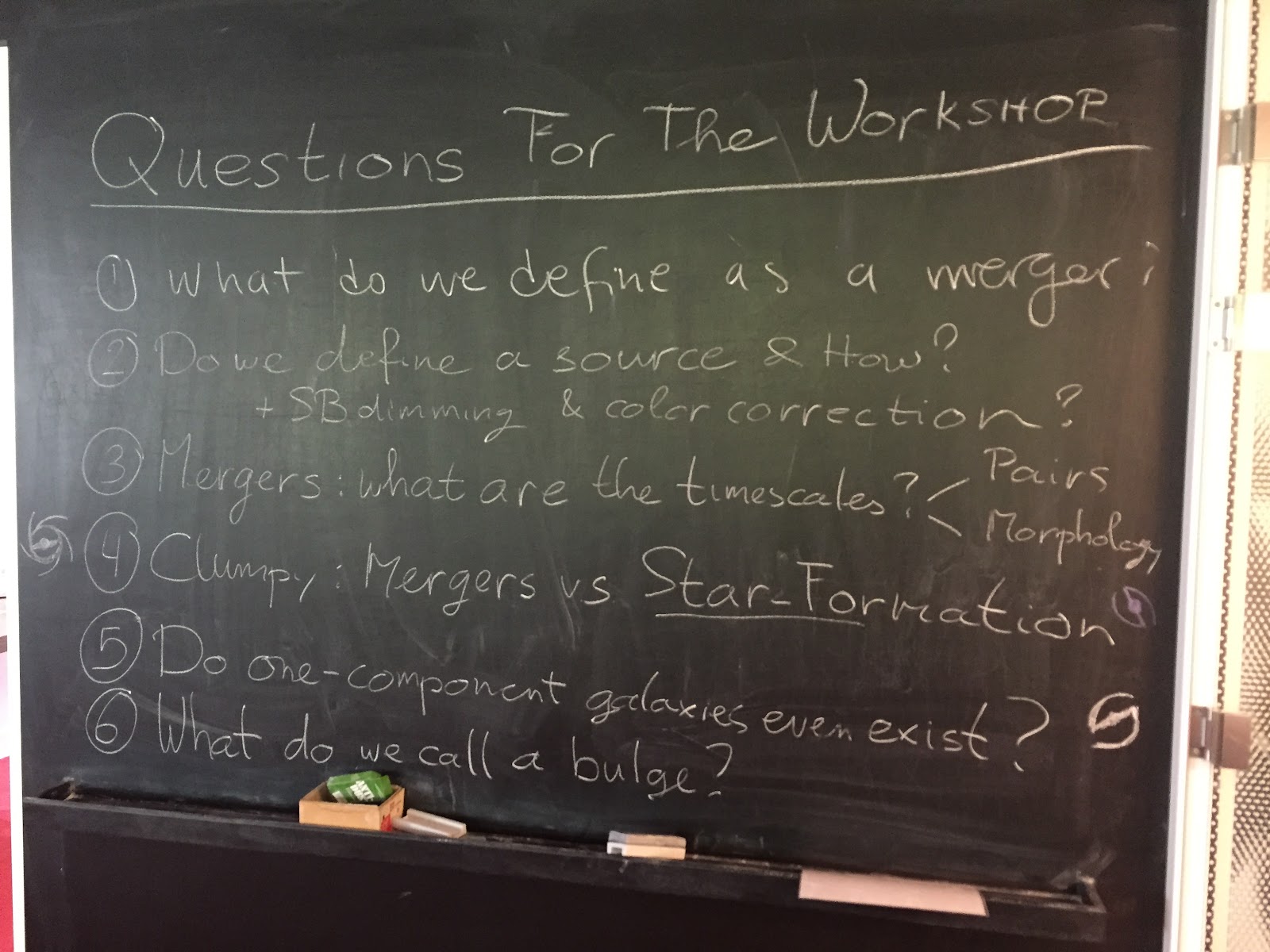
Some of the questions regarding galaxy morphometrics we had...
Subsequently, we loosely stuck to the program but did not enforce time limits since every scheduled talk sparked (welcome) discussion and thus ran typically over. The one exception was by Marc Huertas-Company who had to give his excellent talk on deep-learning techniques via remote/Skype call.
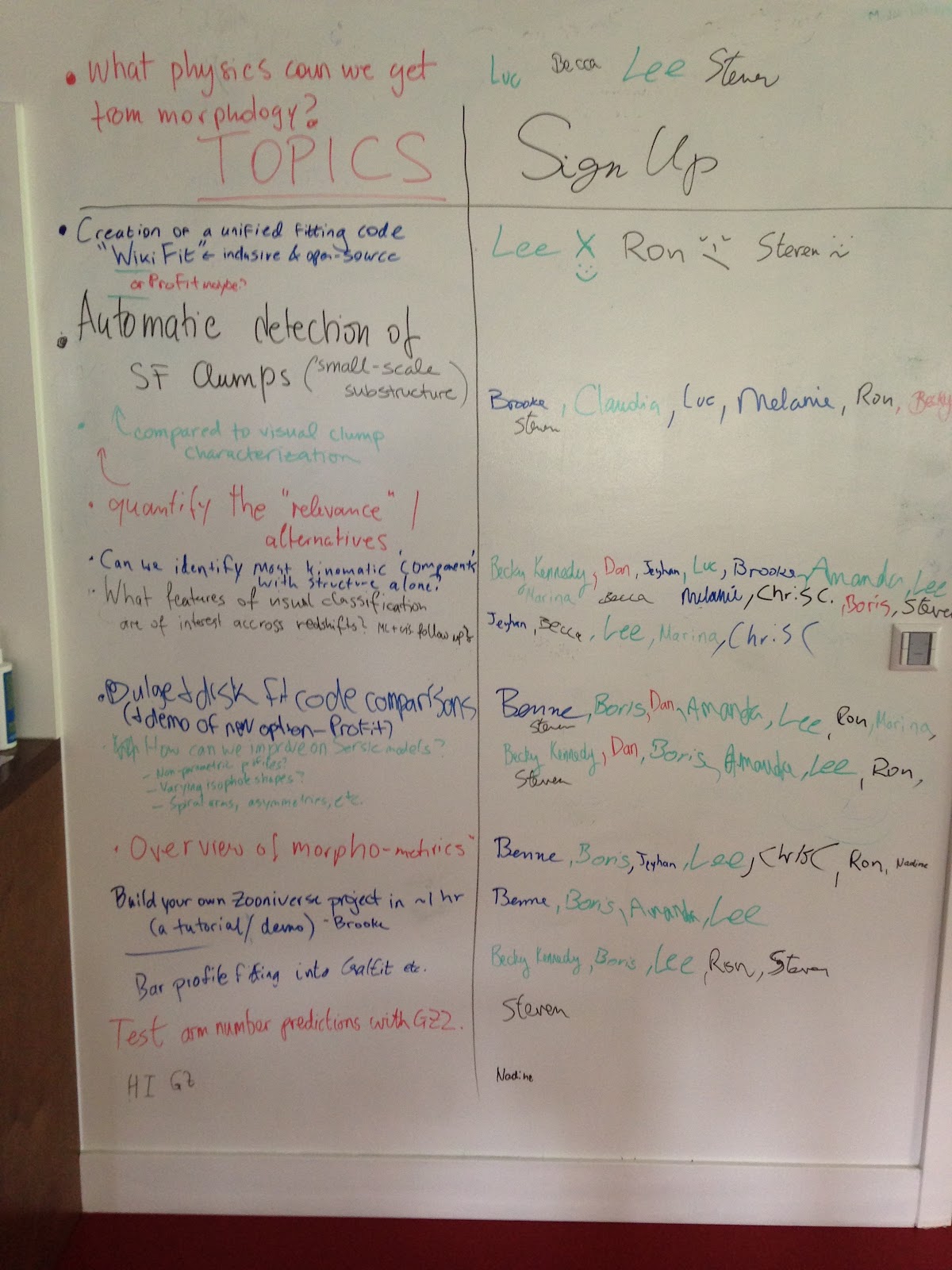
The sign-up board with all the ideas for the hack day (afternoon really).
On wednesday afternoon we had the hack day. To decide which topic was the most interesting to work on, we used the wall in the coffee corner. The workshop split into three groups to tackle a) clump-finding, b) code standards/comparisons and c) combining morphometics and kinematic information. The results from these hack sessions and the talks were discussed on our final session on Friday afternoon.
Conference dinner was on wednesday night.


Photos thanks to Rebecca Lange (mine failed)
Mister M and Miss C made an appearance as well.
We had to make some accommodations and Jeyhan Karteltepe gave her keynote on Thursday. Brooke Simmons gave an un-scheduled, but excellent tutorial on how to start a Zooniverse citizen science project (something we did not get to on the hack day). I am totally pumped up now to start with a dust-lanes-in-edge-on-disks-zoo (better name pending).
The sessions were furiously tweeted by the participants (myself included). These can be found under the hashtag #galmorph and are summarized here:
Twitter Storify of the Galaxy Morphometrics workshop
The workshop was in my estimation an unqualified success and sparked several future projects and collaborations on publicly available (and publicly maintained community-effort) software packages. There was also discussion about a possible follow-up workshop or conference at another location to continue to tackle the galaxy morphometics of all the coming future surveys (e.g. LSST, EUCLID & WFIRST).
Sunday, June 19, 2016
Mild .Astronomy Envy
Matt is going to .astronomy and I cannot even pretend I am not a little jealous. So much coolness coming from that every time. We need to see about bringing it to the Lorentz Center in two years perhaps. It would be an excellent excuse to go back to the Netherlands.
I think both Matt and me feel a little out of place for .astronomy. But hey. Let's see what he learns. Maybe we can hash out an idea about .astronom 10. We would need a theme. Astronomy for Everyone. Astronomy Science Toolbox. A new scisoft would be blessing I feel. Shame Norm does not support that anymore. It almost feels like some people think it will be that STSCI anaconda installation but that is just python. I would need everything else too! Source Extractor!
I will have to live vicareously through Twitter.
I think both Matt and me feel a little out of place for .astronomy. But hey. Let's see what he learns. Maybe we can hash out an idea about .astronom 10. We would need a theme. Astronomy for Everyone. Astronomy Science Toolbox. A new scisoft would be blessing I feel. Shame Norm does not support that anymore. It almost feels like some people think it will be that STSCI anaconda installation but that is just python. I would need everything else too! Source Extractor!
I will have to live vicareously through Twitter.
Monday, April 18, 2016
Using Small Telescopes for Education.
I'm sitting in the "Robotic Telescopes in Education" workshop here in Leiden. It's just before the ALMA deadline, I'm beat from Mister M's 4th birthday party and there were some shenanigans I am apparently supposed to put up with in Academia that had my headspace a bit off. But here we go!
The use of educational telescopes in outreach, classrooms and college education is something I got to thinking about since a recent visit to Moore's Observatory in Louisville.
Las Cumbras is an amazing resource. Easy to schedule, essentially a single telescopes, spread around the globe. Edward Gomez gave us a rundown of the project and immediately, some ideas start spreading in my brain (occasionally bumping up against me stewing because of that unrelated issue).
Matt Kenworthy's projects are those that can benefit scientifically. Given the fact I'm an extra-Galactic astronomer, I cannot realistically think of much that dovetails with what I've been doing so far.
But that is not the use we should be thinking here. How can one use this online resource in classrooms? Pick something bright, pick something that can be observed to change.
And if it also does something for science, then we'd be really talking!
We'll hear from Pedro Russo next about integrating local facilities into classroom activities. Some sort of project where (highschool) students can use local and LCOGT telescopes to do something that in aggregate benefits astronomy. That is my end goal here.
The use of educational telescopes in outreach, classrooms and college education is something I got to thinking about since a recent visit to Moore's Observatory in Louisville.
Las Cumbras is an amazing resource. Easy to schedule, essentially a single telescopes, spread around the globe. Edward Gomez gave us a rundown of the project and immediately, some ideas start spreading in my brain (occasionally bumping up against me stewing because of that unrelated issue).
Matt Kenworthy's projects are those that can benefit scientifically. Given the fact I'm an extra-Galactic astronomer, I cannot realistically think of much that dovetails with what I've been doing so far.
But that is not the use we should be thinking here. How can one use this online resource in classrooms? Pick something bright, pick something that can be observed to change.
And if it also does something for science, then we'd be really talking!
We'll hear from Pedro Russo next about integrating local facilities into classroom activities. Some sort of project where (highschool) students can use local and LCOGT telescopes to do something that in aggregate benefits astronomy. That is my end goal here.
Subscribe to:
Posts (Atom)