Sunday, October 4, 2026

AI-TINA - There Is No Alternative?

Famously said by Margaret Thatcher about her austerity program (“how is Britain doing these days?”) and it echoes in the way AI had been rammed into every crevice of society, including higher ed. 

I’m grappeling with it myself. I don’t want to just categorically shut it down. I have tasks I’d love to get help with. Faculty used to, you know, from people whose job it was to assist with grant submissions, admin and what have you. So you see the appeal. Replace the support system with AI. And then replace the professor as well if possible. That sportsball coach salary has to come from somewhere! 


It’s hard not to get cynical these days. 


But there is a real chance that higher ed may force people to becoming reverse centaurs - people who take their orders from a machine; their tasks and tempo set algorithmically. 


So what should a faculty member do? It should be an option to just go “nah” and do everything yourself. It should but it won’t be. The pressure to perform ever more tasks is already there. This will make it so much worse. 


What is there to give AI?  


Stuff you don’t want to do. (Reporting, admin, tedious email chains)


Stuff you suspect don’t matter in the long run or you don’t care about (same stuff really). 


Stuff you don’t want to get good at. 


That last one is a much better metric. Do I want to get good at my annual report? Do I want to improve my writing? Do I want to get good at teaching? Do I want to improve my letters of recommendation? 


In principle yes to all of these. I want to put my best work in to pretty much all. But if said pressure to do more more more increases, then what? 


First off is put as much as you can in systems, not AI. Filter emails, have a set of criteria for students before they work with you. Have a set of criteria for you to stop working with them (ie your values). Set up templates and workbooks for recurring tasks. 


And then, maybe include some AI in some of those systems. And because we are talking systems that you are designing, not being pressured into, maybe even adopt local AI/LLM for those tasks. 


I guess I am arguing for intentional AI adoption. There are alternatives!


Saturday, August 29, 2026

AI in Academia - An experiment with an annual report

AI in Academia — An experiment with an annual report


The kind of image a Google Image search produces for “AI Professor”


A confession first: I have not used AI* in any serious capacity so far. There have been many an instance where there was an opportunity to play around and I have done so. Mostly chatGPT or similar or demonstrations of how well Gemini could summarize documents. I have not really used it for coding. I like my code simple since otherwise I cannot follow myself.

*really large language models, something separate from machine learning, which I have used professionally and teach about.

But the noise around AI has grown to a crescendo. To the point that our University has given us access to a Google account with Gemini specifically for AI usage. So I decided to a more controlled experiment. Not something that is open-ended and just generates the frizz of possibilities but something that would a) save me time, and b) save a headache that I have to go through annually and c)there is a decent experiment for me to set up.

The other trend in Academia, at least in the USA, is to ask for more and more status reporting and accountability. Professors are evaluated on an annual and often now on a longer period timescale as well. You get to justify your existence and employment over and over. This requires documentation and summary documents of that documentation.

Perfect! This is a task that I would like to avoid and involves meticulous summary of many many documents that I would love to pawn off to a machine. I read somewhere that AI generated text is for documents you don’t expect to be read really by people. Or by real people. I forget.

So I took my 2024 documentation pile and fed it into Gemini. And this is an experiment so I can check how well it did compared to the actual summary document I wrote with much sweat & swearing in 2025.

I fed it a CV, the various documents attesting I had reviewed a paper or similar, student evaluations, a prize certificate for advising, and the emails I had chucked into the “merit review 2024” as perhaps somewhat pertaining to what I was up to.

There are three categories in a typical evaluation: teaching, research (papers & grants), and service.

The Gemini generated document — after some fiddling with the prompt — generated a very convincing looking summary document for the first two. There was enough in the whole ensemble to make something that looked like what I had written up. Just with fewer spelling mistakes. The style was…very linked-in-y if you catch my drift. Call it Calvinism, call it Northern European upbringing (oh wait those are the same), call it my personality but it contained more explicit rah-rah than I would have done myself.

However, the mentoring of students and much of the service I had done was missing. So if you are using any “AI” to generate documents like that, please understand that this is where it will be underselling you to the administration. It looks like you could take on some more service work!

The reason is simple, it was not in the data. Student evaluations are easy to digest but supervising a student and their good experience with you is much much harder to capture in the documents like the ones I fed it. And putting thattogether is typically one of the more laborious parts of the annual reporting document. So unless you want to add a heap of personal data (here is access to my email accounts and photo library?), it will not show you the kind of work that makes the big impact on students, the reason they come to you for projects or take your classes. It doesn’t show your work on a public event or a committee.

Would it save me time? Maybe some. It would certainly get me started on this task-I-prefer-to-avoid. But there is a real risk that it may undersell what you’re trying to show. And if a potential cost-of-living-expenses “merit” raise is on the line, it might not be worth it. An actual human may read this.


Wednesday, February 11, 2026

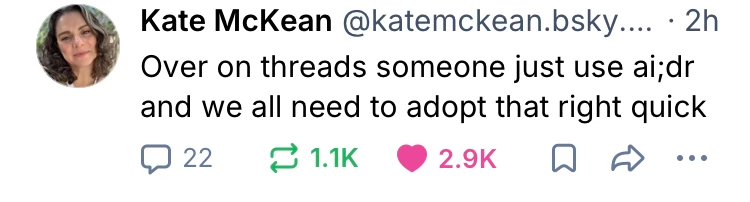
AI:DR


I saw this on the social media and it’s an excellent summary of how I feel about AI generated text. I went to several of our teaching and learning sessions and there was an honest effort to engage with the AI generation features offered now through the Microsoft suite and Blackboard. This is a new tool, there is lots of hype around it, let’s see what we can do.

And I was there to give it a merry go.

Maybe it speeds things up. A lot of setting up of course material etc feels like stuff i would happily hand over to a machine (“figure out when the spring break is and set deadlines on Friday accordingly.”)

The education team that was giving us the workshop “ai as a TA” (hmmm do these folks know what AITA stands for already?) gamely tried to show us what they were using and how. And maybe it could sorta work? You have a built in chatbot TA teaching Socratically (asking follow-up questions). Ehm? Yeah the chat adventure games from the 1980s could mostly do that (“AITA has been eaten by a Gru”).

What isn’t addressed is how stuff like this would be received. The galaxy zoo team could have probably done some foreshadowing. There it’s very difficult to have people engage with simulated I.e. “fake” galaxy images. People hate it. Discover new and interesting real stuff? Everyone is enthusiastic. Fake? Off they go.

So I would have to expend quite a bit of effort to a) check the ai isn’t hallucinating and b) that the students suspect nothing.

Yeah that’s too much stress for me. Pass.

And I don’t blame the students. I would just reply AI:DR to anything I suspected what generated this way. If you can’t be bothered to write it, I can’t be bothered to read it. And what kind of standing does an instructor have if they outsource their teaching of a topic — that they are supposedly an expert in — to a machine, a slop machine to boot!

But I hope this abbreviation catches on. Imagine emailing that back to some long winded email…